12 Nisan 2019 Cuma

ESREFOGLU MOSQUE

Esrefoglu Mosque
Beysehir, Konya
Eşrefoğlu Mosque is the only wooden mosque where several decorative techniques of stone, brick, ceramics and painting were used together.

It is still a mystery how the wooden portions of the mosque, built in 1299, lasted until today without decay Eşrefoğlu Mosque, built in 1299 in the Beyşehir district of the central Anatolian province of Konya, is an architectural mystery.
How the wooden parts of the mosque survived until today without decay has baffled scientists. The seven-century-old mosque has a special place in Turkish architecture since it is the only wooden mosque where several decorative techniques of stone, brick, ceramics and painting were used together.
Built by Eşrefoğlu Süleyman Bay in 1297-1299, Eşrefoğlu Mosque is known as the biggest flat-ceiling mosque placed on wooden pillars, the Anatolia news agency reported. The historical building is still open to worship and is considered a “Turkish museum made of wood” thanks to its superior handicraft of wood and ceramics.
Eşrefoğlu Mosque, a unique example of Islamic architecture, is also noteworthy for its wooden pillars as well as ornaments and fresco paintings on the ceiling.


ÇATALHÖYÜK 

Catalhoyuk is known as one of the earliest settlements in the neolithic age, located in Cumra district of Konya. It is the largest and best preserved neolithic site found to date. There are no footpaths or streets between dwellings, so rooftops were their streets.
Neolithic Site of Catalhoyuk, included to UNESCO's World Heritage List in 2012 on cultural criteria. There are magnificent examples of the art of the period on this wonderfully preserved site. That is why it has been declared a UNESCO World Cultural Heritage.
KONYA

• Konya has been a host for many cultures and civilizations with its rich historical past. Konya , which has been a home for the first Christian settlement and sanctuaries, has a very important potential in culture tourism. In this context, Konya has been aiming to be one of the important centers for Cultural tourism besides religious tourism.
• There is one UNESCO World Heritage Site (Neolithic Site of Çatalhöyük) and four in UNESCO World Heritage Tentative List in Konya (Eşrefoğlu Mosque, Konya -A Capital of  Seljuk Civilisation, Anatolian Seljuk Medrasas and Eflatunpınar: Hitite Water Monument)
• Important historical values like Sille (Siyata), Aya Elena Church, Kilistra Antique City, Eflatunpınar Hittite Monument, Çatalhöyük, Karahöyük, İvriz Rock Reliefs, Bolat, Nekropol ve Bouleterion has been showing the potential of Konya in terms of Cultural tourism.
• Traditional handicrafts and folcloric values of Konya are a part of Cultural tourism. Various crafts such as felt and carpet production, spoon making, rifle production, pottery and calligraphy attracts foreign tourists to Konya. Semah, folk dances and sufi music forms the main folkloric values of Konya.
• Konya carries histroical marks spanning 9 millenia. Konya has a very rich heritage such as ruins, historical and natural protected areas, caverns and civil architecture.
• Konya, once the capital city of Seljuk Sultanae of Rum, has an important tourism potential with Rumi and Nasrettin Hodja who are well known personalities worldwide.
• Konya has a total bedding capacity of 4.663 in facilities with tourism operation license. There are also 29 restaurants with tourism operation license and 110 travel agencies.
• There are 11 museums in Konya, 7 of which are downtown (Mevlana, Karatay Madrasa, İnceminare, Sırçalı Medrese, Atatürk, Etnography and Archeology Museum) and 4 are in districts.(Çatalhöyük Museum, Ereğli Museum, Akşehir West Front Encampment Museum and Akşehir Archeology Museum.)
• In 2014, almost 2.5 million people have visited museums of Konya.
• There are 2 handwritten artifacts museums in Konya; Region Handwritten Works Library and Yusufağa Library. There are 18.118 handwritten works and 75.503 printed books and a total of 91.621 books in these libraries.


UNESCO WORLD HERITAGE IN TURKEY

There are 60 nominated sites in the Tentative List of UNESCO World Heritage. This site aims to promote the sites inscribed on the UNESCO World Heritage List and raise awareness in transferring Turkey’s cultural heritage to future generations.
Turkey’s sites in the Tentative List of UNESCO World Heritage:
  • Karain Cave, Antalya (1994)
  • Sümela Monastery, Trabzon (2000)
  • Alahan Monastery, Mersin (2000)
  • St. Nicholas Museum (Church), Antalya (2000)
  • Harran and Şanlıurfa Settlements, Şanlıurfa (2000)
  • The Tombstones of Ahlat the Urartian and Ottoman citadel (2000)
  • Seljuk Caravanserais on the route from Denizli to Doğubeyazıt (2000)
  • Konya, A Capital of Seljuk Civilization (2000)
  • Alanya (2000)
  • Mardin Cultural Landscape (2000)
  • St. Paul Church, St. Paul’s Well and Surrounding Historic Quarters, Mersin (2000)
  • Ishak Pasha Palace, Ağrı (2000)
  • Kekova, Antalya (2000)
  • Güllük Mountain-Termessos National Park, Antalya (2000)
  • Archaeological Site of Aphrodisias, Aydın (2009)
  • Ancient Cities of Lycian Civilization, Antalya and Muğla (2009)
  • Archaeological Site of Sagalassos, Burdur (2009)
  • Archaeological Site of Perge (2009)
  • Archaeological Site of Göbeklitepe, Şanlıurfa (2011)
  • Beyşehir Eşrefoğlu Mosque, Konya (2011)
  • St. Pierre Church, Hatay (2011)
  • Aizanoi Antique City (2012)
  • Historic City of Ani (2012)
  • Archeological Site of Zeugma (2012)
  • Gordion (2012)
  • Historic Town of Birgi (2012)
  • Mausoleum and Sacred area of Hecatomnus (2012)
  • Medieval City of Beçin (2012)
  • Historical Monuments of Niğde (2012)
  • Yesemek Quarry and Sculpture Workshop (2012)
  • Odunpazari Historical Urban Site (2012)
  • Mamure Castle (2012)
  • Haci Bektas Veli Complex (2012)
  • Archaeological site of Laodikeia (2013)
  • Lake Tuz Special Environmental Protection Area (SEPA) (2013)
  • Trading Posts and Fortifications on Genoese Trade Routes from the Mediterranean to the Black Sea (2013)
  • The Ancient City of Sardis and the Lydian Tumuli of Bin Tepe (2013)
  • İznik (2014)
  • Zeynel Abidin Mosque Complex and Mor Yakup (Saint Jacob) Church (2014)
  • Tomb of Ahi Evran (2014)
  • Vespasianus Titus Tunnel (2014)
  • Mahmut Bey Mosque (2014)
  • Archaeological Site of Kültepe-Kanesh (2014)
  • Ancient City of Kaunos (2014)
  • Anatolian Seljuks Madrasahs (2014)
  • Archaeological Site of Arslantepe (2014)
  • Ancient City of Korykos (2014)
  • Ancient City of Anazarbos (2014)
  • Çanakkale (Dardanelles) and Gelibolu (Gallipoli) Battles Zones in the First World War (2014)
  • Eflatun Pinar: The Hittite Spring Sanctuary (2014)
  • Akdamar Church (2015)
  • The Theatre and Aqueducts of the Ancient City of Aspendos (2015)
  • Eshab-ı Kehf Kulliye (Islamic-Ottoman Social Complex) (2015)
  • Historic Guild Town of Mudurnu (2015)
  • Mount Harşena and the Rrock-tombs of the Pontic Kings (2015)
  • Mountainous Phrygia (2015)
  • Ancient City of Stratonikeia (2015)
  • The Bridge of Uzunköprü (2015)
  • Ismail Fakirullah Tomb and its Light Refraction Mechanism (2015)
  • Yıldız Palace Complex (2015)
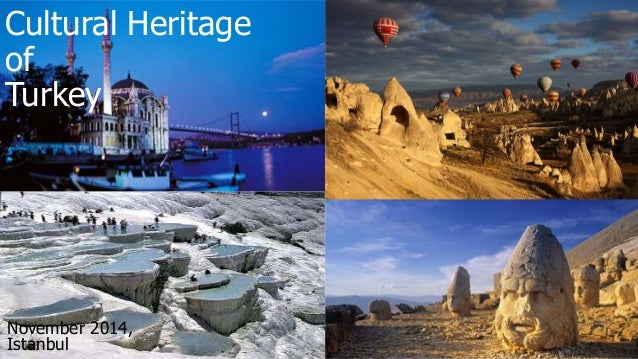
CULTURAL HERITAGES OF TURKEY

CULTURAL HERITAGES OF TURKEY ile ilgili görsel sonucu

An important subject to be remembered in the world and in Turkey too, is the preservation of cultural values, so that these can be handed down to future generations.
Turkey is lucky in that it has a richness and variety in cultural and natural resources and the preservation and development of these have been stipulated by law. Many organizations have been set up in connection with this subject and preservation has now become a subject that concerns many organizations, institutions and people.
Turkey has approximately 2,700 historical ruins some dating back to prehistoric times and 41,000 works of culture.
OUR CULTURAL HERITAGE

Culture in Development

Cultural Heritage is an expression of the ways of  developed by a community and passed on from generation to generation, including customs, practices, places, objects, artistic expressions and values. Cultural Heritage is often expressed as either Intangible or Tangible Cultural Heritage (ICOMOS, 2002).
As part of human activity Cultural Heritage produces tangible representations of the value systems, beliefs, traditions and lifestyles. As an essential part of culture as a whole, Cultural Heritage, contains these visible and tangible traces form antiquity to the recent past.